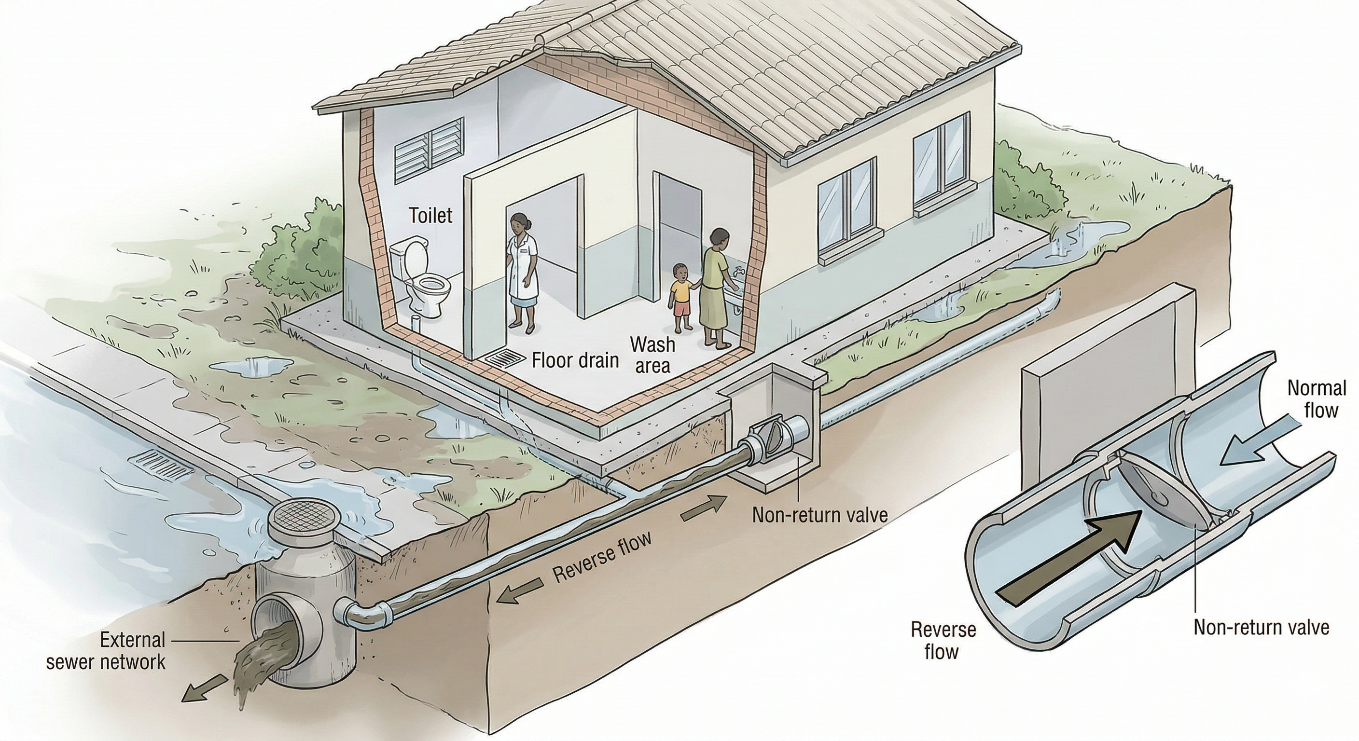
Non-return valves in sewer and service connections
Non-return valves in sewer and service connections are devices installed to prevent reverse flow when floodwater surcharges external wastewater or drainage networks. In practice, they are used to stop contaminated water from re-entering the facility through sewage pipes, storm drains, floor drains, or other connected fixtures. Depending on the system, this may involve check valves, combination check-and-gate valves, ball-float devices, or ejector arrangements with backflow protection for fixtures below expected surcharge levels [1–4].
For PHC in LMICs, this measure usually has a very strong cost-value profile. Compared with broader floodproofing works, nonreturn valves are often a targeted intervention with high practical value because they protect toilets, wash areas, drains, and nearby clinical spaces from sewage intrusion. In flood-prone facilities, even shallow flooding can make consultation rooms, maternal and newborn care areas, and sanitation facilities unsafe if contaminated backflow enters through service lines. For that reason, this is one of the clearest examples of a focused measure with major operational benefits [1,3–5].
This measure is mainly compatible with retrofit and adaptation. It is especially useful where existing facilities have known risks of sewer surcharge or backflow through connected drains and fixtures. In most PHC settings, it can be introduced without redesigning the whole building, although some installations may require more specific plumbing adjustments depending on fixture elevation, pipe layout, and the expected surcharge pathway [1–3].
Implementation and maintenance complexity is generally low to medium. Procurement is usually more straightforward than for major flood barriers or specialized envelope systems, and installation relies on standard plumbing expertise rather than highly specialized engineering. However, the measure still requires correct specification, proper installation, and periodic inspection to ensure reliable function over time. In some cases, more complex arrangements may be needed where fixtures are located below expected surcharge levels [1–2,6].
For PHC facilities, non-return valves are highly relevant because sewer backflow directly affects the minimum conditions needed for safe care. If toilets, floor drains, or wastewater connections fail during floods, the result is not only physical damage but also contamination, loss of dignity, and disruption of essential services. This has immediate implications for infection prevention, maternal and newborn care, outpatient consultations, and the safe use of sanitation facilities. In flood-prone LMIC settings, this makes non-return valves one of the most practical and important protective measures for routine PHC infrastructure [3–5].
Examples / evidence
FEMA states that facilities should install backflow prevention valves on wastewater lines to prevent floodwater mixed with sewage from entering buildings, and also notes that a combination check valve and gate valve provides particularly effective protection against sewage backflow [1].
Primary Protection provides a concrete health-sector example from the 2008 flood at Mercy Medical Center in Cedar Rapids, where the overwhelmed city sewer system caused severe backup into the hospital’s lower levels, forcing staff to remove toilets and sinks and plug the openings before evacuation [4]. The same report explains that rising floodwaters may force untreated sewage to back up through toilets or floor drains, and notes that specially designed backflow prevention devices can be installed to reduce this risk [4].
The World Bank also lists non-return valves in sewage pipes among building design measures to reduce floodwater entry through service connections [3].
EPA’s flood resilience guide includes installation of backflow prevention devices on sewers and drains among low-cost building flood mitigation options, and FEMA’s wastewater systems fact sheet recommends backflow prevention devices on influent and emergency overflow lines to prevent inundation of lift stations by the collection system and overflow. 23 Together, these references show that sewer backflow is not a minor maintenance issue, but a major threat to continuity and safe operation in health facilities [1,4,6–7].
References
Federal Emergency Management Agency. Hurricane and Flood Mitigation Handbook for Public Facilities. Washington, DC: FEMA; 2022.
Federal Emergency Management Agency. Design Guide for Improving Hospital Safety in Earthquakes, Floods, and High Winds. Washington, DC: FEMA; 2007.
World Bank. Resilient, Green, and Inclusive Health Facilities: Guidance on Planning, Design, and Operation. Washington, DC: World Bank; 2025.
U.S. Department of Health and Human Services. Primary Protection: Enhancing Health Care Resilience for a Changing Climate. Washington, DC: HHS; 2014.
World Health Organization, United Nations Children’s Fund. Water and Sanitation for Health Facility Improvement Tool (WASH FIT): A Practical Guide for Improving Quality of Care through Water, Sanitation and Hygiene in Health Care Facilities. 2nd ed. Geneva: WHO; 2022.
U.S. Environmental Protection Agency. Flood Resilience: A Basic Guide for Water and Wastewater Utilities. Washington, DC: EPA; 2014.
Federal Emergency Management Agency. Fact Sheet 4.2: Wastewater Treatment Systems. In: Hurricane and Flood Mitigation Handbook for Public Facilities. Washington, DC: FEMA; 2022.