Deployable flood barriers / anti-flood gates
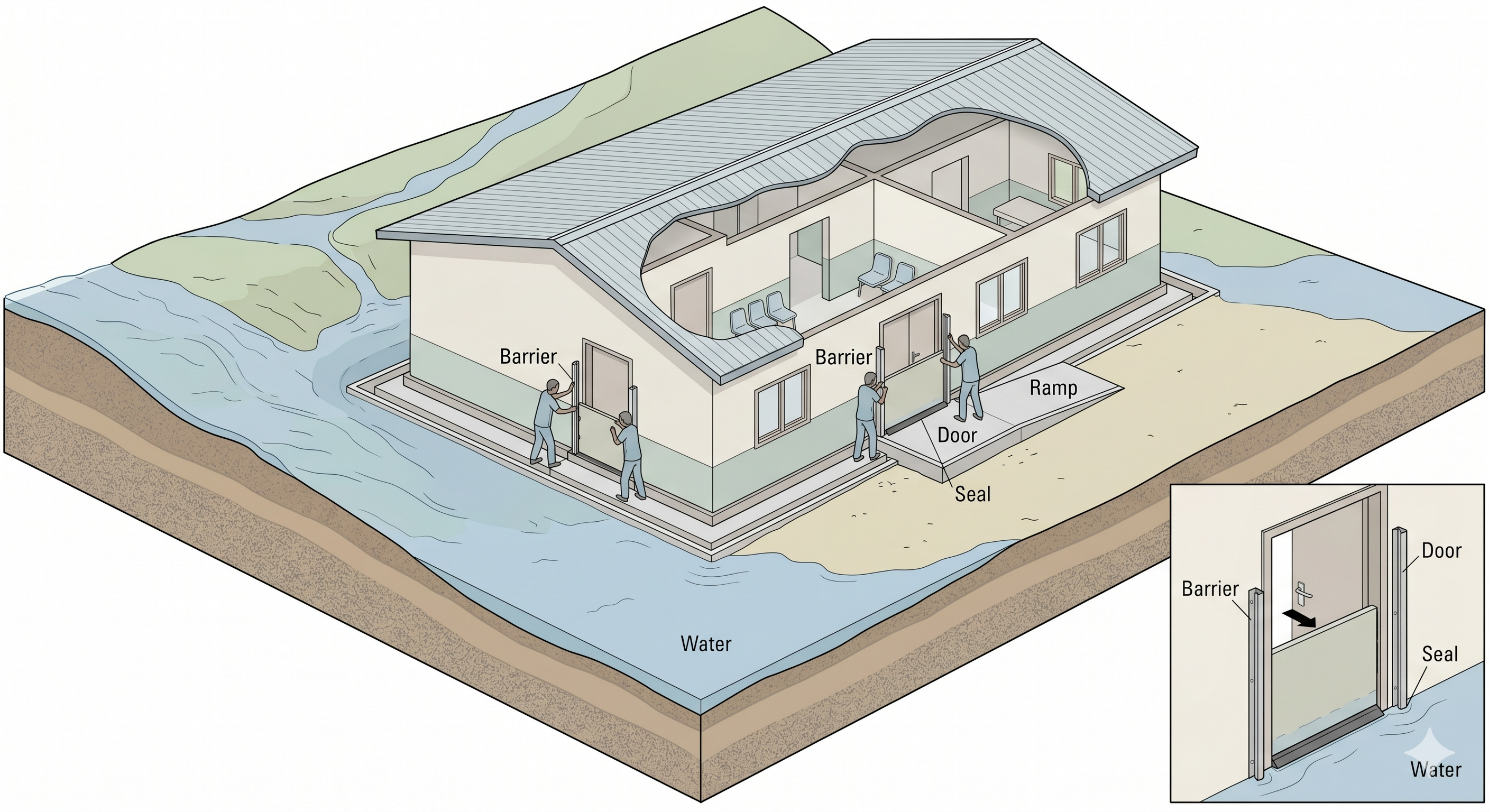
Deployable flood barriers and anti-flood gates are protective elements used to block floodwater from entering exposed openings, entrances, ramps, or other vulnerable access points during a flood event. In practice, these systems may be removable, hinged, sliding, lift-out, modular, or self-activating, and are typically installed only where water entry is expected. Their main purpose is to protect critical openings or short perimeter sections without redesigning the entire facility or site [1–2,5].
For PHC in LMICs, the cost-value profile of this measure is usually moderate rather than high. It can be justified where a small number of highly exposed openings determine whether the facility can remain operational during shallow flood events. However, it is often less attractive for routine PHC use because it involves equipment costs, storage needs, and recurring operational requirements. In practice, it is usually more suitable for selected high-risk facilities than for broad use across PHC
networks [1,3].
This measure is mainly compatible with retrofit and adaptation. It is most useful where an existing facility has specific doorways, ramps, loading points, or perimeter gaps that need targeted protection. Unlike broader site redesign measures, deployable barriers can sometimes be added without major reconstruction. Their effectiveness, however, depends heavily on local flood depth, watertight detailing, and the availability of enough warning time for correct deployment [1–2,5].
Implementation and maintenance complexity is generally high. Long-term viability depends not only on procurement and installation, but also on storage conditions, staff training, drills, inspection, and maintenance. Effective operation also depends on having clear emergency procedures and on completing deployment before floodwaters reach the protected openings [3,6].
For PHC facilities, deployable flood barriers are most relevant where service continuity depends on protecting a few exposed openings rather than floodproofing the entire site. In those situations, they may help preserve access and prevent disruption to consultation rooms, circulation points, or service areas. Because of their operational demands, however, they are generally better suited to selected high-risk facilities than to routine use across small PHC facilities in resource-constrained settings [2–3].
Examples / evidence
FEMA describes deployable barriers as active or passive systems and notes that manually deployed options can include hinged, drop-in or lift-out, sliding, bolt-on, and modular systems, while also indicating that they are generally most effective against relatively shallow flooding and may have relatively high life-cycle costs [1]. FEMA’s hospital design guidance also notes that exposed access points may be protected with manually installed stop-logs or designed gates, but that sufficient warning
time is needed for access protection to work effectively [2]. The World Bank provides a health-sector example from Kurashiki Central Hospital in Japan, where removable flood barriers were selected after flood risk analysis showed potential for prolonged disruption and high recovery costs. The case also notes that staff deploy the barriers under a flood response plan and that disaster drills are used to support implementation [4].
This example illustrates both the value of the measure and the level of preparedness required for it to function well in practice
References
Federal Emergency Management Agency. Hurricane and Flood Mitigation Handbook for Public Facilities. Washington, DC: FEMA; 2022.
Federal Emergency Management Agency. Design Guide for Improving Hospital Safety in Earthquakes, Floods, and High Winds. Washington, DC: FEMA; 2007
World Bank. Resilient, Green, and Inclusive Health Facilities: Guidance on Planning, Design, and Operation. Washington, DC: World Bank; 2025
World Bank. Resilient, Green, and Inclusive Health Facilities: Guidance on Planning, Design, and Operation. Washington, DC: World Bank; 2025.
Federal Emergency Management Agency. NFIP Technical Bulletin 3: Requirements for the Design and Certification of Dry Floodproofed Non-Residential and Mixed-Use Buildings. Washington, DC: FEMA; 2021.
Federal Emergency Management Agency. Floodproofing Non-Residential Buildings (FEMA P-936). Washington, DC: FEMA; 2013.