Permeable surfaces and reduced hardscaping
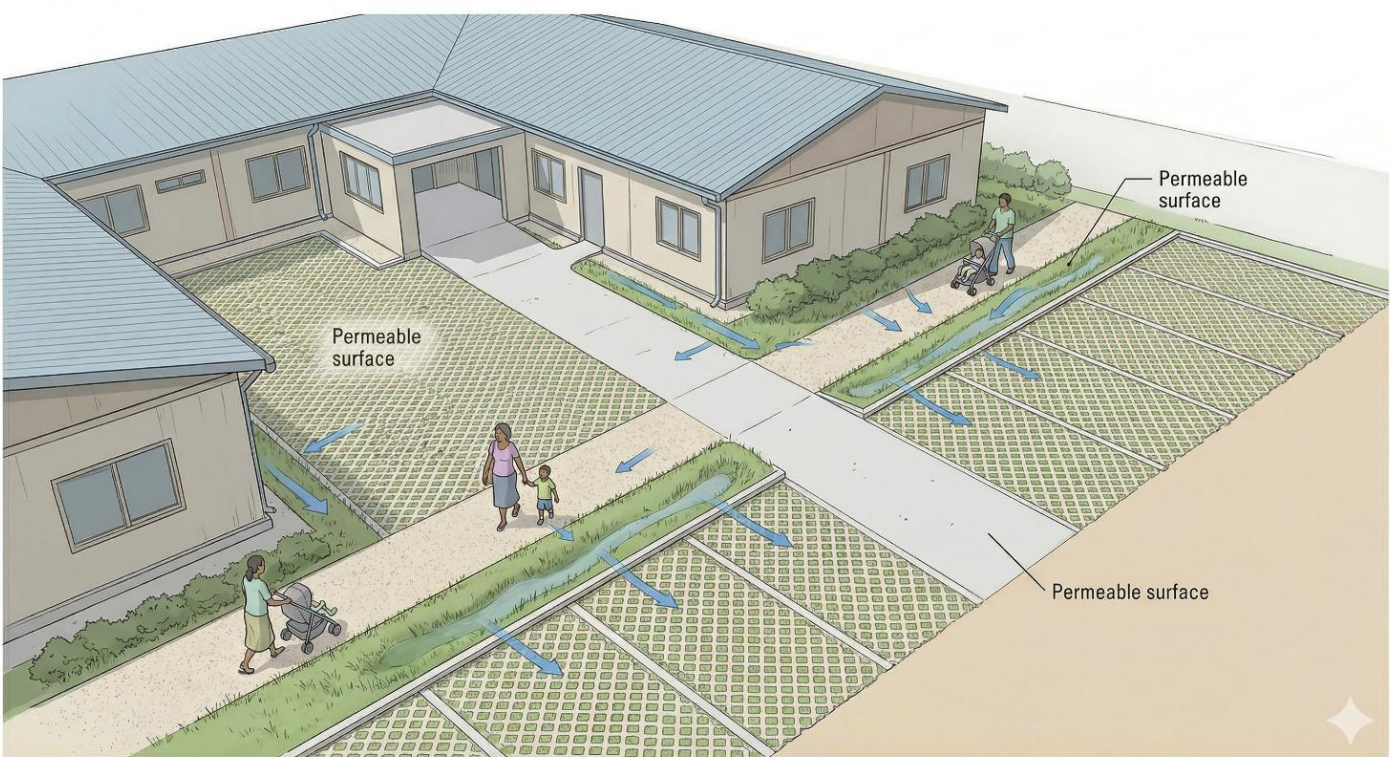
Permeable surfaces and reduced hardscaping refer to site layouts and external materials that allow more rainwater to infiltrate into the ground instead of rapidly running off across sealed paved areas. In practice, this includes reducing impermeable paving and using permeable paving, porous surfaces, vegetated strips, swales, and other landscape-based measures that help slow, absorb, store, and redirect stormwater. In PHC facilities, these measures are especially relevant around entrances,
pedestrian routes, courtyards, parking areas, and service yards, where runoff accumulation can create standing water, localized flooding, and access problems [1–2,6].
For PHC in LMICs, this measure usually has a strong cost-value profile when used as part of a broader flood-risk reduction strategy. It is generally less costly and less technically demanding than major engineered flood-control works, while stillimproving runoff management, circulation, and site usability. Its contribution is usually supportive rather than primary,however. In most PHC settings, permeability measures are most effective when combined with drainage correction, runoff conveyance, or other direct flood-protection measures rather than treated as a stand-alone solution [1–2].
This measure is compatible with both retrofit / adaptation and new construction. In existing facilities, it can often be introduced gradually by replacing selected paved areas, reducing sealed surfaces, or adding swales and other permeable landscape features where space permits. In new construction, it can be integrated more effectively through early site planning, grading, and circulation design. This flexibility is important for PHC because the same measure can be applied through different scales of intervention depending on site constraints and budget [1,7].
Implementation and maintenance complexity is generally low to medium. Basic landscaping and paving solutions are often available through standard construction channels, but permeable pavement systems require correct detailing and periodic maintenance to avoid sediment buildup, clogging, and loss of infiltration performance over time. Technical guidance also notes that design choices may vary according to site and subgrade conditions, including full, partial, or low infiltration
configurations [2,6–7].
For PHC facilities, permeable surfaces and reduced hardscaping are relevant because they help keep access routes safer and reduce the runoff burden on local drainage systems during heavy rainfall. This can support continuity of care by protectingentrances, walkways, and outdoor service areas, and by helping prevent water accumulation around spaces used by pregnant women, children, and caregivers. Their relevance is therefore strong, although usually secondary to measures such as
drainage improvement, utility protection, or direct flood exclusion [1–2].
Examples / evidence
Several references illustrate the value of permeability-based measures in health settings. Reduction of hardscaping to increase permeability is listed among site-level flood risk reduction measures for health facilities, together with wetland landscaped zones, drainage systems, and physical barriers [1]. The same guidance also recommends increasing ground permeability through soft landscaping, swales, and other permeable materials, and allowing places for floodwater to collect in
detention basins, ponds, or wetland areas as part of site flood management [1]. Primary Protection describes bioswales at Kiowa County Memorial Hospital as part of a strategy to filter stormwater and support aquifer recharge, while rooftop rainwater was collected for irrigation and toilet flushing [3]. The same document also
describes the Texas Medical Center as using advanced stormwater management, open space for stormwater recharge, and a large detention pond as part of a broader hazard mitigation approach [4]. In the Caribbean, the Smart Hospitals Toolkit documents how flooding and road damage during Hurricane Tomas affected
access and service continuity in several Saint Lucia health facilities, reinforcing the importance of site runoff and access
management [5].
References
World Bank. Resilient, Green, and Inclusive Health Facilities: Guidance on Planning, Design, and Operation. Washington, DC: World Bank; 2025.
ederal Emergency Management Agency. Hurricane and Flood Mitigation Handbook for Public Facilities. Washington, DC: FEMA; 2022
3. U.S. Department of Health and Human Services. Primary Protection: Enhancing Health Care Resilience for a Changing Climate. Washington, DC: HHS; 2014
U.S. Department of Health and Human Services. Primary Protection: Enhancing Health Care Resilience for a Changing Climate. Washington, DC: HHS; 2014.
Pan American Health Organization. Smart Hospitals Toolkit. Washington, DC: PAHO; 2017
U.S. Environmental Protection Agency. Stormwater Best Management Practice: Permeable Pavements. Washington, DC: EPA; 2021
Federal Highway Administration. Use of Permeable Pavements. Washington, DC: FHWA; 2023.