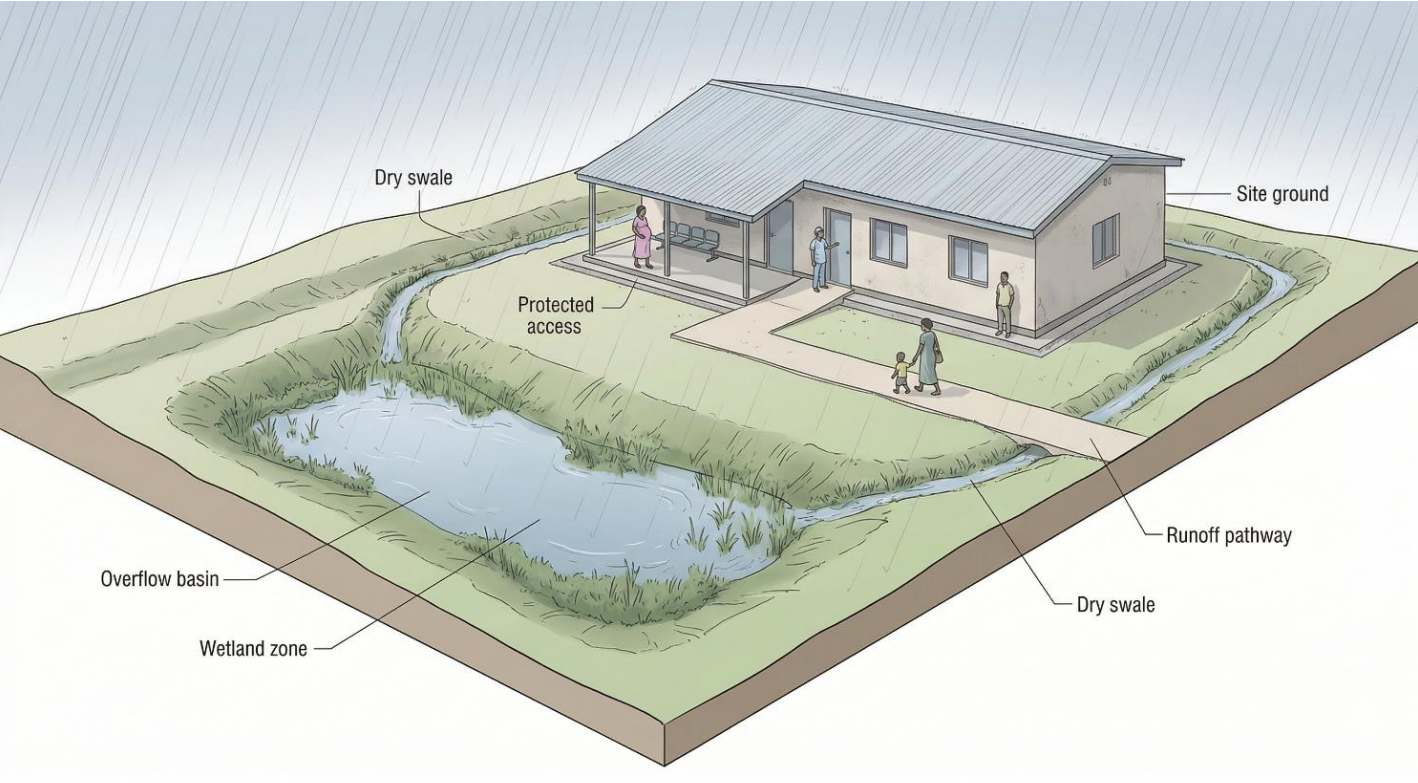
Overflow basins / wetland landscaped zones
Overflow basins and wetland landscaped zones are site-level features designed to temporarily retain excess rainwater during intense rainfall events and reduce pressure on buildings, access routes, and site utilities. In practice, this includes detention basins, wet ponds, bioretention areas, dry swales, and constructed wetland systems that store runoff for a limited period and then release or infiltrate it gradually. These systems reduce peak runoff, limit erosion, protect downstream drainage capacity,
and decrease the likelihood of water accumulation around the facility [1–3,7].
For PHC in LMICs, this measure can provide meaningful flood-risk reduction benefits, but its cost-value profile is usually more moderate than simpler drainage interventions. It is most appropriate where flood risk is driven by runoff accumulation across the site and where sufficient land is available to integrate retention areas. In smaller PHC facilities with constrained plots or limited capital budgets, these systems are often less feasible than direct drainage improvements or targeted flood-protectionmeasures [1–2].
This measure is generally more compatible with new construction or major adaptation than with routine retrofit. It relies on coordinated site planning, grading flexibility, hydraulic design, and available open space to function effectively. In existing facilities—especially those with dense layouts or extensive hardscaping—these conditions are often difficult to achieve without substantial reconfiguration [1–2,8].
Implementation and maintenance complexity is typically medium. While the systems themselves are not highly specialized, they require integrated design across drainage, landscape, and site engineering. Their performance depends on maintaining storage capacity, vegetation health, and flow pathways over time. Stormwater guidance highlights that detention systems can lose effectiveness if sediment accumulation reduces storage or if maintenance is not sustained, and that hydraulic performance depends on correct sizing and outlet control structures [1,7].
For PHC facilities, overflow basins and wetland landscaped zones are relevant because they reduce flood pressure at the site level and help protect circulation routes, utilities, and building access. This supports continuity of care by reducing disruption during heavy rainfall events. However, their relevance is typically greater in larger campuses, new developments, or major redevelopment projects than in small-scale PHC upgrades. They are therefore best understood as supportive resilience measures rather than first-line priorities in most LMIC PHC contexts [2–3].
Examples / evidence
Several examples illustrate the application of these systems in health settings. Overflow basins and wetland landscaped zones are listed among site-level measures to reduce flood risk in health facilities, together with drainage systems, landscape-based retention areas, and physical flood barriers [2]. Primary Protection describes the Texas Medical Center as part of a long-term mitigation strategy that included advanced stormwater management, open space for infiltration, and a large detention pond integrated into the campus layout [4].
The Landscape Performance Series documents multiple healthcare projects using retention and wetland systems. At Owensboro Health Regional Hospital, a network of retention basins and a detention pond temporarily store runoff before releasing it downstream, helping reduce flood risk across the site [5]. At Virtua Voorhees Hospital, constructed wetlands receive and filter runoff from rooftops, parking areas, and other hard surfaces before it enters preserved natural systems [6]. These examples show that such systems can be effective at scale, particularly in larger healthcare campuses, but are more difficult to implement in space-constrained PHC facilities [4–6]
References
Federal Emergency Management Agency. Hurricane and Flood Mitigation Handbook for Public Facilities. Washington, DC: FEMA; 2022.
World Bank. Resilient, Green, and Inclusive Health Facilities: Guidance on Planning, Design, and Operation. Washington,DC: World Bank; 2025.
World Health Organization. Checklists to Assess Vulnerabilities in Health Care Facilities in the Context of Climate Change. Geneva: WHO; 2021
U.S. Department of Health and Human Services. Primary Protection: Enhancing Health Care Resilience for a Changing Climate. Washington, DC: HHS; 2014.
Jiang S, Kaljevic S. Owensboro Health Regional Hospital. Landscape Performance Series. Landscape Architecture Foundation; 2017
Jiang S, Kaljevic S. Virtua Voorhees Hospital. Landscape Performance Series. Landscape Architecture Foundation; 2016.
U.S. Environmental Protection Agency. Stormwater Best Management Practice: Detention Basins. Washington, DC: EPA; 2021.
Federal Highway Administration. Stormwater Best Management Practices in an Ultra-Urban Setting: Selection and Monitoring. Washington, DC: FHWA; 2010.