Site drainage improvement
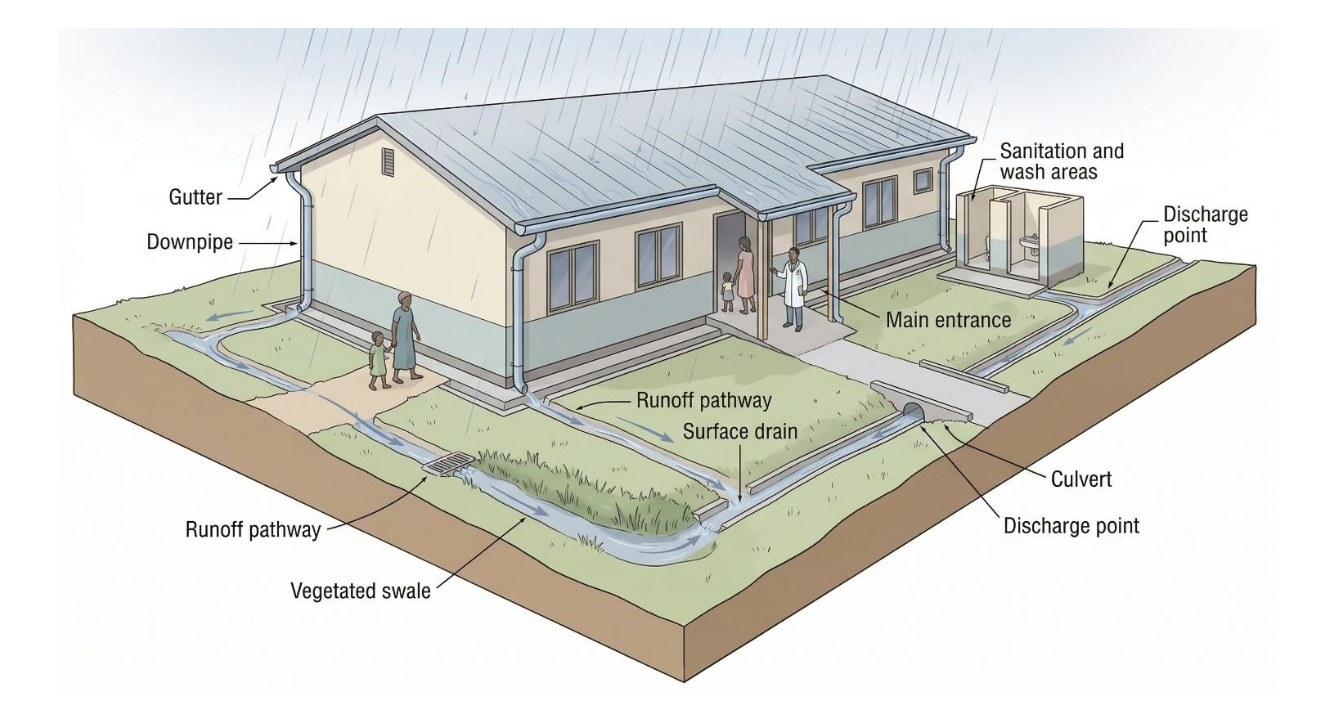
Permeable surfaces and reduced hardscaping refer to site layouts and external materials that allow more rainwater to infiltrate into the ground instead of rapidly running off across sealed paved areas. In practice, this includes reducing impermeable paving and using permeable paving, porous surfaces, vegetated strips, swales, and other landscape-based measures that help slow, absorb, and redirect stormwater. In PHC facilities, these measures are especially relevant around entrances,
pedestrian routes, courtyards, parking areas, and service yards, where runoff accumulation can create standing water, localized flooding, and access problems [1–2,6].
For PHC in LMICs, this measure usually has a good cost-benefit profile when used as part of a broader flood-risk reduction strategy. It is generally less costly than larger engineered flood-control works and can improve runoff management, circulation, and site usability at the same time. However, its value is usually supportive rather than primary. In most PHC settings, permeability measures are most useful when combined with more direct drainage and flood-protection measures rather than treated as a stand-alone solution [1–2]. Permeable pavement has also been described as a way to reduce pavement ponding and localized flooding while decreasing the need for some conventional conveyance infrastructure [6].
This measure is compatible with both retrofit / adaptation and new construction. In existing facilities, it can often be introduced gradually by replacing selected paved areas, redesigning external surfaces, or adding landscape-based runoff features where space allows. In new construction, it can be integrated more effectively through early site planning, grading, and circulation design. This flexibility helps explain why it is relevant in many PHC settings, even if implementation pathways differ [1,6].
Its implementation and maintenance complexity is generally low to medium. Basic landscape and paving solutions are often available through standard procurement, but some options—especially permeable pavement—require correct installation and periodic maintenance to avoid clogging and performance loss over time [2]. Technical pavement guidance also notes that these systems should usually drain stored stormwater within 24 to 72 hours after a storm event and must be designed for both
hydraulic and structural performance [7]. This means the measure is feasible in many PHC settings, but it is not maintenance- free [2,7].
For PHC facilities, Site drainage improvement and reduced hardscaping are relevant because they help keep access routes safer and reduce the runoff burden on local drainage systems during heavy rainfall. This can support continuity of care by protecting entrances, walkways, and outdoor service areas, and by helping prevent water accumulation around spaces used by pregnant women, children, and caregivers. Its relevance is therefore strong, although usually secondary to measures such as drainage correction, utility protection, or direct flood exclusion [1–2,6].
Examples / evidence
Several references illustrate the value of permeability-based measures in health settings. Reduction of hardscaping and increased ground permeability are listed among site-level measures to reduce flood risk in health facilities [1].Bioswales at Kiowa County Memorial Hospital were used to filter stormwater and support aquifer recharge, while rooftop rainwater was collected for irrigation and toilet flushing [3]. The Texas Medical Center also incorporated advanced stormwater management, open space for stormwater recharge, and a large detention pond as part of a broader hazard mitigation strategy[4].
In the Caribbean, flooding and road damage during Hurricane Tomas affected access and service continuity in several Saint Lucia health facilities, reinforcing the importance of site-level runoff and access management [5]. Permeable pavement, bioswales, and related green infrastructure measures have also been described as practical ways to absorb stormwater while improving pedestrian circulation and reducing hardscape-related heat burden in outdoor areas [6].
1.1 References
Federal Emergency Management Agency. Design Guide for Improving Hospital Safety in Earthquakes, Floods, and High Winds. Washington, DC: FEMA; 2007
World Health Organization, United Nations Children’s Fund. Water and Sanitation for Health Facility Improvement Tool (WASH FIT): A Practical Guide for Improving Quality of Care through Water, Sanitation and Hygiene in Health Care Facilities. 2nd ed. Geneva: WHO; 2022.
U.S. Department of Health and Human Services. Primary Protection: Enhancing Health Care Resilience for a Changing Climate. Washington, DC: HHS; 2014.
Federal Emergency Management Agency. Hurricane and Flood Mitigation Handbook for Public Facilities. Washington, DC:FEMA; 2022
Pan American Health Organization. Smart Hospitals Toolkit. Washington, DC: PAHO; 2017.
Federal Highway Administration. Urban Drainage Design Manual (HEC-22), Third Edition. Washington, DC: FHWA; 2009
World Health Organization. Discussion Paper: Climate, Sanitation and Health. Geneva: WHO; draft discussion paper.