
The way forward: Time to commit - 1
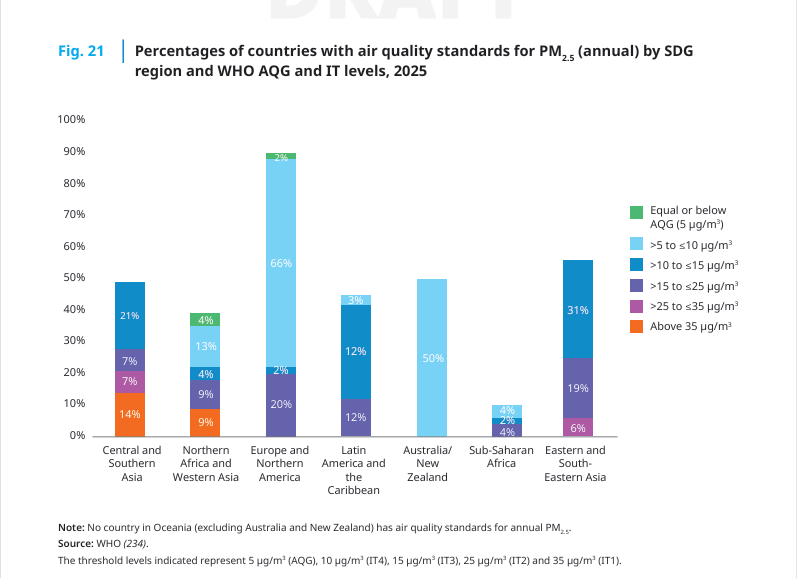
Air pollution is the leading environmental risk for children’s health and that of future generations. Exposure to polluted air cuts short the lives of hundreds of thousands of children every year, damages their lungs and brains and limits their chance to live long, healthy, flourishing lives. Many countries have made important progress in recent decades in improving air quality and protecting children from PM, O3 , SO2 , NO2 and other airborne threats (including lead). In some parts of the world, however, progress is offset by the impacts of climate change, and children’s exposure to harmful air pollution is increasing as a result of population growth in many developing countries. Thus, the air pollution crisis is far too often overlooked. The most powerful protective measures are policies to reduce air pollution at source. © UNICEF/UNI486516/Karimi These include adoption and enforcement of legally binding air quality standards to prevent exposure by preventing pollutants from reaching the air – and children’s lungs. This requires addressing the major sources of household air pollution, including the use of polluting fuels and technologies for cooking, heating and lighting, through context specific, equitable policies and interventions for clean household energy. Globally, 44% of countries have annual air quality standards for PM2.5 , of which more than half are high-income countries (234). In those countries, implementation of the standards would protect children immediately (235). Of LMIC, however, only 31% have air quality standards for annual PM2.5 , and the proportion is as low as 10% in sub-Saharan Africa (Fig. 21).
Much as they rely on adults for nourishing food, shelter and clean water, children depend on adults to ensure that the air they breathe is safe. Children are society’s most voiceless constituency; they are largely powerless to reduce or prevent their exposure to air pollution. Their suffering is not inevitable. The burden can be lifted. What’s needed is more coordinated action – and a sense of urgency.
Everyone has a role to play – families and parents, caregivers, paediatricians, family doctors, nurses, obstetricians, primary care providers, CHWs, educators, medical students, urban planners, industry and business leaders, youth themselves, national government ministries and international agencies. Decision-makers at every level can act to curb the polluting activities that are damaging children’s health and destabilizing the climate they will inherit. This will require collective action – intensive collaboration among a wide range of sectors, from transport to energy to agriculture and urban planning.
Equipped with the knowledge summarized in this report of the diverse and devastating impacts of air pollution on children’s health and of the proven interventions that could prevent that damage, key actors must now commit themselves to action.
Global initiative for clean air and better health
A recent milestone in the clean air movement occurred in March 2025, when over 700 participants from 100 countries joined WHO’s second Global Conference on Air Pollution and Health (2) and backed a bold goal to halve the health impacts of air pollution by 2040, prompting commitments from over 50 governments, cities, UN agencies and civil society. The commitments include concrete steps to:
- enforce strict air quality standards, reduce emissions at their source and align with the WHO global AQG;
- move from fossil fuels fairly and equitably to ensure that the clean energy transition is inclusive and accessible to all;
- prioritize clean household energy for cooking, heating and lighting in national health and climate policies and strategies to reduce household air pollution and advance towards meeting net-zero commitments;
- improve monitoring systems and institutional capacity to address air quality;
- increase domestic and international funding for clean air as a priority on global and national agendas; and
- create and support development and training of a multisectoral workforce to ensure that communities and stakeholders can tackle air pollution effectively.
References
Updated road map for an enhanced global response to the adverse health effects of air pollution. Report by the Director-General. WHO Executive Board, 156th Session, 27 January 2025 (https://apps.who.int/gb/ ebwha/pdf_files/EB156/B156_24-en.pdf).
Second global conference on air pollution and health, 25–27 March 2025, Cartagena, Colombia. Geneva: World Health Organization; 2025 (https://www.who.int/news-room/events/detail/2025/03/25/default calendar/second-global-conference-on-air-pollution-and-health).
Clean air, healthy children: an agenda for action. Protecting children from seven deadly sources of air pollution. Policy brief. New York City: United Nations Children’s Fund; 2024 (https://www.unicef.org/reports/ clean-air-healthy-children-agenda-action).