
Interventions to protect children from air pollution
4.1 Interventions for clean air and healthy children: A multisectoral, strategic challenge
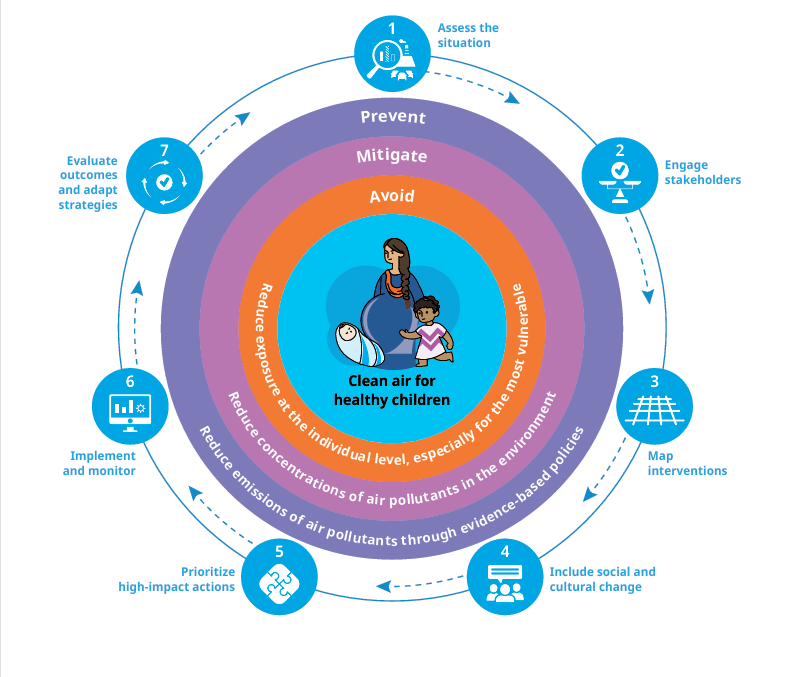
This section presents a summary of multisectoral policies and technological and behavioural interventions to protect mothers, newborns, children and adolescents from air pollution. It introduces a framework for identifying and prioritizing the most effective interventions.
4.1.1 Multilevel interventions
The most effective intervention for improving air quality and protecting health is to reduce emissions. Any individual measure should be seen not as a substitute for but complementary to long term planning and multisectoral interventions by government authorities and institutions to reduce air pollution emissions (140). Multisectoral policy interventions and individual actions are often closely linked. For example, effective policies to promote replacement of polluting household energy devices with clean fuels and appliances must take into account and respond to the financial constraints and cultural factors that shape individual choices. Likewise, policies to increase the use of clean, safer transport must include means to serve individual users and respond to their needs. Successful policies lift the burden of avoiding air pollution from the individual as much as possible by making it easier for them to both choose and access clean air solutions.
The list of interventions proposed here is broad but not exhaustive (141); the examples should be tailored and adapted to each context and need. Many of the measures could be implemented immediately in homes, schools and communities around the world, including in urban environments. The interventions respond to the damage of maternal exposure to polluted air on fetal health and therefore the importance of antenatal care and clean air for women of reproductive age before and during pregnancy. Clean, safe environments are essential for children to grow and develop, with good health, adequate nutrition, complete vaccination, safety and security, learning opportunities and responsive care (142–144). Parents, educators, community leaders, health professionals, private sector representatives and policy-makers should all be involved.
4.2 Hierarchy and prioritization of interventions to reduce air pollution
4.3 Reducing exposure in households, schools and communities
4.2.1 Households
About one quarter of the world’s population, 2.1 billion people, still rely primarily on solid fuels such as wood, crop waste, charcoal, coal, dung and kerosene on open fires and inefficient stoves for cooking (154). As chronic exposure to household air pollution poses such significant risks, interventions for households potentially offer large benefits for the health and well-being of mothers and children, as children spend much of their time in and around their homes. Interventions should be relevant to the context. In many LMIC, the primary source of household air pollution is combustion of fuels such as biomass in inefficient devices for cooking, heating and lighting. In high-income and many middle-income countries, most households meet their basic needs with energy sources that are cleaner for health and produce less fine PM and air pollutants, such as electricity and gaseous fuels. Children in higher income settings can still, however, face health risks Fig. 18 from household air pollution, especially in families of low socioeconomic status (155). Increasing access to and adoption of clean fuels and technologies at the point of use are essential to protect children from household air pollution, to reduce ambient pollution and to meet the SDG 7 target of universal access to clean energy by 2030. The WHO definitions of “clean”, “transitional” and “polluting” household energy are available in the WHO Guidelines for indoor air quality: household fuel combustion (45) and on the WHO webpage “Defining clean fuels and technologies” (156). Household energy solutions that meet WHO’s definition of “clean” include the following fuels and technologies.
4.4 Strengthening health systems for child health and clean air
The health-care needs of pregnant women, newborns, children and adolescents in the context of climate and air pollution risks have been largely neglected in the broader policy response to climate change (176). In May 2024, ministers of health at the World Health Assembly committed themselves to tackle the leading, mostly preventable causes of maternal and newborn deaths by improving access to maternal, sexual and reproductive health and comprehensive child health services through stronger primary health care (1,37). They also agreed to address climate change more holistically (177,178). Health systems contribute to environmental pollution and carbon emissions globally, including through the supply chain of product manufacture, procurement, distribution, use, waste creation and disposal. Health systems thus face a dual challenge in protecting maternal, newborn and child health. They must be strengthened to address the health impacts of air pollution, and they must reduce their own environmental impact.